To understand the difference it makes to have policies reflecting the resurrection, we first need to identify what Jesus accomplished for us in being raised from the dead.
Results of the Resurrection of Jesus Christ
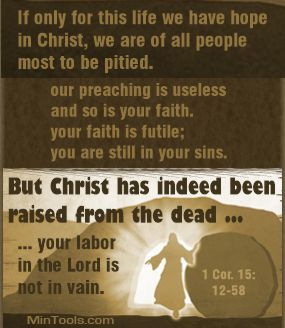 Scripture clearly describes the Christian life without the resurrection as bleak and empty. — “If only for this life we have hope in Christ, we are of all people most to be pitied.” (1 Cor. 15:19)
- our preaching is useless and so is your faith. (1 Cor. 15:14)
- your faith is futile; you are still in your sins. (1 Cor. 15:17)
As a result of the resurrection, however, we move from…
- emptiness to meaning (1 Cor. 15:13-17)
- condemnation to forgiveness and being made right with God (1 Cor. 15:17-18; Rom. 8:33-39)
- despair to hope (1 Cor. 15:19, 32; 1 Pet. 1:3)
- death to life (1 Cor. 15:22, 45; Rom. 6:4-11)
- defeat to victory (1 Cor. 15:54-58; Phil. 3:10)
The conclusion to all of this? — “Therefore, my dear brothers and sisters, stand firm. Let nothing move you. Always give yourselves fully to the work of the Lord, because you know that your labor in the Lord is not in vain.” (1 Cor. 15:58)
Are Our Policies Reflecting the Resurrection?
Let’s watch that our policies don’t give people a feeling like their labor in the Lord is in vain. If people feel like they’re being held back by too much meaningless red tape, discouragement sets in. The resurrection gives life, meaning, and purpose. It empowers and frees us to become all we were made to be rather than putting us in bondage.
When we’re attuned to reflecting the power of the resurrection, even in our policy-making, it will affect the kind of policies we develop. They will be that which …
enhance lives and enable true ministry to abound.
It’s difficult for people to give themselves “fully to the work of the Lord” when they are boxed in by man-made rules and regulations that make it difficult to move forward.
help people live like they’ve “been raised with Christ” and help them set their “hearts on things above, where Christ is, seated at the right hand of God” (Col. 3:1).
When conformity and pleasing leadership become the goal, focus gets diverted from where it should be. Rather than putting “on the new self, which is being renewed in knowledge in the image of its Creator” (Co. 3:10), people tend to let these expectations consume them and move them from ministering from their position with Christ in the heavenly realms (Eph. 2:6).
Policies may be necessary but make sure they reflect the life-giving, purposeful hope, light, and freedom of the resurrection. Otherwise, don’t be surprised if policies fail to truly protect, provide, and promote. Rather than leading to love and peace, they’ll tend to divide and produce conflict.
For More on These Topics:
All Posts about Policy Making:
- Policy Making Objectives
- Policy Making Parameters
- Policy Making & the Big Picture
- Policy Making & Freedom in Christ
- Policies with No Hidden Agendas
- Policies Reflecting Both Grace & Truth
- Church Policies & the Next Generation
- Don’t Let Policies Take on a Life of Their Own
- Spiritual Gifts in Determining Policies
- Spiritual Gifts for Writing Policies
- Spiritual Gifts Suited for Implementing Policies
- Turning to God or to Church Policies?
- God’s Your Defender, Not Your Church Policies
- Policies Shaped by the Gospel
- Policies Reflecting the Gospel
- Policies Shaped by Grace
- Policy-Making Safeguarded by Grace
- Why Policies When We Have God’s Word?
- Power to Maintain the Proper Focus in Policymaking
- Policies Reflecting the Resurrection
- Church Policies Done in the Name of the Lord Jesus
- Leadership Qualities that Positively Affect Policy Making
- Biblical Leadership Roles Positively Affect Policy Making
- Shepherding and Policy Making