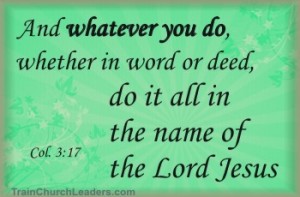
When Scripture says, “whatever you do” in Colossians 3:17, it means just that — all and everything we do. That, of course, means church policies must also be done in the name of the Lord Jesus.
To make sure we’re clear, read on –“And whatever you do, whether in word or deed …” The original term for “word” doesn’t specify whether that be spoken or written words but the encompassing nature of this verse would undoubtedly refer to any form of communication, including written church policies. Our deeds, when it comes to church policies, could entail the process of writing them as well as their enforcement. We’re to “do it all in the name of the Lord Jesus”, meaning that even church policies must be done because of and through the power of His name. When we do whatever we do in the Lord’s name, we’re reflecting who He is.
Reflecting the Name of the Lord Jesus in Our Church Policies
To help us understand how our church policies can, and should, reflect the Lord’s name, look at the various names given to Jesus in Scripture. Each alias depicts an aspect of who He is. It shouldn’t matter which name is used. If our policies are worth having He should be pleased to sign any of His names to them because they reflect His character and ways.
Jesus is the “Light of the World” (Jn. 8:12) shining forth with the brilliance, or glory, of the totality of who He is, coming together as light that shines in a dark world. Policies must therefore reflect both grace and truth, goodness and righteousness, mercy and justice, etc..
For you were once darkness, but now you are light in the Lord. Live as children of light (for the fruit of the light consists in all goodness, righteousness and truth) and find out what pleases the Lord. (Rom. 5:8-10)
As the “Alpha and Omega” (Rev. 22:12-13) who is the beginning and the end, He knows the big picture. Policies should contribute to God’s greater purposes not be petty and nit-picky about things that don’t really matter in the big scheme.
And he is the head of the body, the church; he is the beginning and the firstborn from among the dead, so that in everything he might have the supremacy. (Col. 1:18) Therefore do not let anyone judge you by what you eat or drink, or with regard to a religious festival, a New Moon celebration or a Sabbath day. These are a shadow of the things that were to come; the reality, however, is found in Christ. (Col. 2:16-17)
He is the “Bread of Life” (Jn. 6:35) who provides what we truly need to sustain us. Our church policies should be more about providing for a healthy and wholesome Church rather than being that which hampers growth and advancement by stifling the fullness of the life He came to give us.
The thief cometh not, but for to steal, and to kill, and to destroy: I am come that they might have life, and that they might have it more abundantly. (Jn. 10:10)
Jesus goes by the names of “Good Shepherd” (Jn. 10:11) and “Chief Shepherd” (1 Pet. 5:4). As such He guides rather than controls, protects rather than smothers, and provides rather than restricts. Policies should likewise enhance our lives, helping us reach our potential rather than box us in and lead to dysfunction and unhealthy conditions.
Be shepherds of God’s flock that is under your care, watching over them—not because you must, but because you are willing, as God wants you to be; not pursuing dishonest gain, but eager to serve; not lording it over those entrusted to you, but being examples to the flock. (1 Pet. 5:2-3)
He is the “Prince of Peace” (Isa. 9:6) who reconciles us with God the Father and brought together into one Church people who were hostile to one another. Church policies must be written and used in a way that aims toward uniting rather than dividing, toward building up rather than destroying.
For the kingdom of God is not a matter of eating and drinking, but of righteousness, peace and joy in the Holy Spirit, because anyone who serves Christ in this way is pleasing to God and receives human approval. Let us therefore make every effort to do what leads to peace and to mutual edification. (Rom. 14:17-19)
As the “Lord of lords and King of kings” (Rev. 17:14), He is the sovereign One, not us. Consequently we yield all we do, including our policies, to Him, aligning with His purposes, design, and mission rather than follow the ways of the world.
Do not conform to the pattern of this world, but be transformed by the renewing of your mind. Then you will be able to test and approve what God’s will is—his good, pleasing and perfect will. (Rom. 12:2)
We could continue on, name by name. Who He is, as described by His name, will affect what we do. Let’s make sure even our church policies are done in the name of the Lord Jesus for there’s power in that name.
For More on These Topics:
All Posts about Policy Making:
- Policy Making Objectives
- Policy Making Parameters
- Policy Making & the Big Picture
- Policy Making & Freedom in Christ
- Policies with No Hidden Agendas
- Policies Reflecting Both Grace & Truth
- Church Policies & the Next Generation
- Don’t Let Policies Take on a Life of Their Own
- Spiritual Gifts in Determining Policies
- Spiritual Gifts for Writing Policies
- Spiritual Gifts Suited for Implementing Policies
- Turning to God or to Church Policies?
- God’s Your Defender, Not Your Church Policies
- Policies Shaped by the Gospel
- Policies Reflecting the Gospel
- Policies Shaped by Grace
- Policy-Making Safeguarded by Grace
- Why Policies When We Have God’s Word?
- Power to Maintain the Proper Focus in Policymaking
- Policies Reflecting the Resurrection
- Church Policies Done in the Name of the Lord Jesus
- Leadership Qualities that Positively Affect Policy Making
- Biblical Leadership Roles Positively Affect Policy Making
- Shepherding and Policy Making